
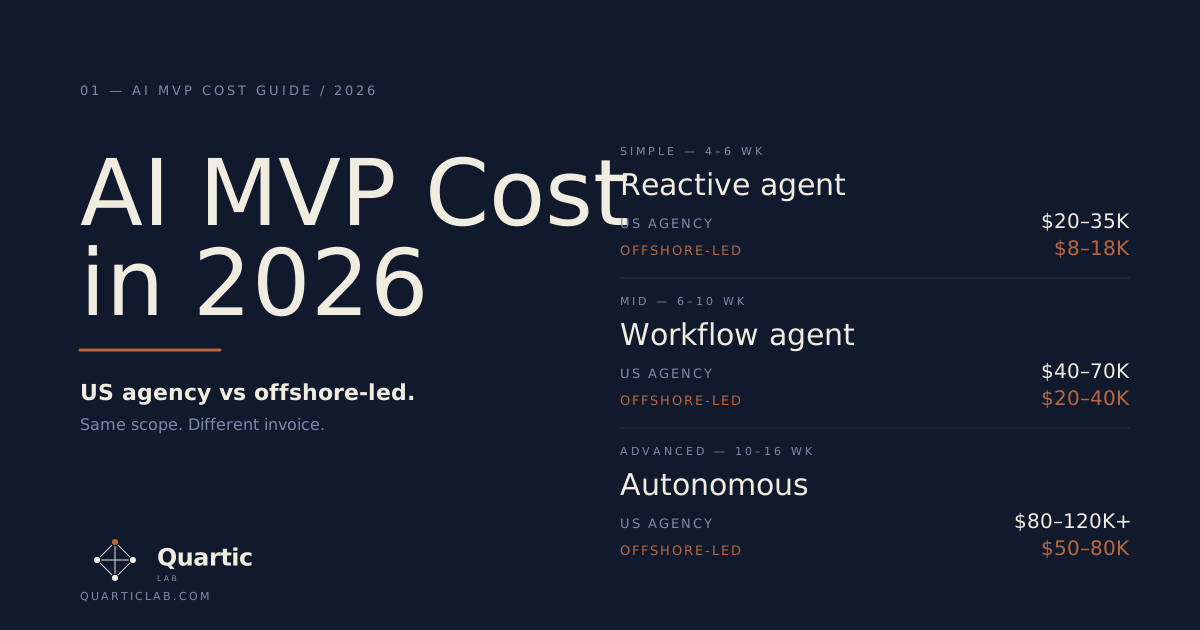
A working AI MVP in 2026 costs $20,000 to $120,000 from a US agency — or $8,000 to $50,000 from an offshore-led team for the same scope. The spread comes from team location, not skill. This piece is for founders and CTOs scoping their first agentic product before they sign a statement of work. By the end you’ll know which tier matches your idea, what gets billed outside the dev quote, and whether a US agency, an offshore team, or an in-house hire makes the math work.
What an AI MVP actually costs in 2026
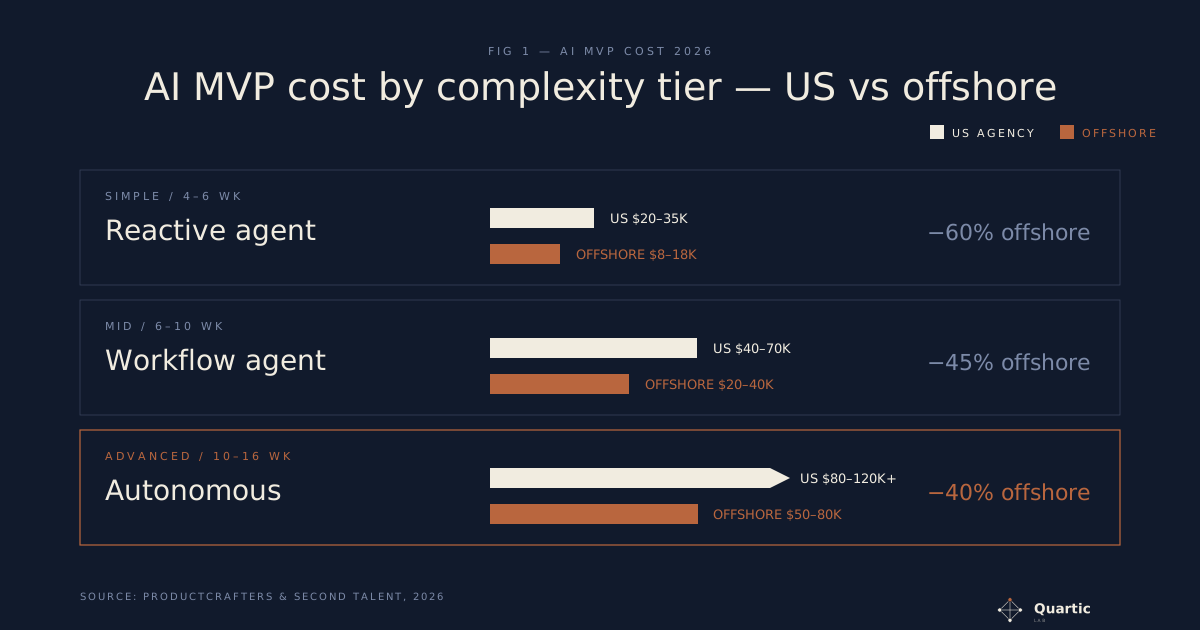
Three honest tiers, each tied to scope. Simple reactive agent — a customer-support chatbot or FAQ assistant grounded in your docs — runs $20,000 to $35,000 from a US agency, $8,000 to $18,000 from an offshore-led team, in four to six weeks (Productcrafters, 2026; Second Talent, 2026). Mid-complexity agent that runs multi-step workflows, calls tools, and handles retrieval against your private data lands at $40,000 to $70,000 US, $20,000 to $40,000 offshore, in six to ten weeks. Autonomous systems — multi-agent orchestration, write-back to systems of record, hand-offs across CRM and billing — start at $80,000 US ($50,000 offshore) and cross $120,000 fast (Productcrafters, 2026).
Most founders we speak to overestimate the model and underestimate the integrations. The model is a commodity now. The wiring is where budgets live.
Where the money actually goes
A scoped AI MVP quote breaks down roughly like this (Productcrafters, 2026):
- Discovery and design — 15 to 20 percent. Use cases, eval criteria, success metrics.
- Model setup and grounding — 20 to 35 percent. RAG pipeline, fine-tuning if needed, eval harness.
- Integration and workflows — 25 to 40 percent. The biggest line item. APIs, webhooks, queue, auth, tool calls.
- Testing and validation — 10 to 15 percent. Adversarial prompts, regression suites, hallucination guardrails.
- Deployment and monitoring — 15 to 25 percent. Observability, token-spend dashboards, on-call playbook.
Two costs founders forget on the first call: token spend and compliance. LLM tokens, cloud, retraining, and audits eat 30 to 50 percent of first-year total cost of ownership on top of the build (DesignRush, 2026). SOC 2, HIPAA, or GDPR alone tack 30 to 50 percent onto a dev quote when they’re in scope (DesignRush, 2026). And model rates matter at scale: Claude Sonnet 4.6 runs $3 input and $15 output per million tokens, with prompt caching cutting cached input by 90 percent and batch processing knocking 50 percent off the bill (Anthropic, 2026). Move enough volume and that decision changes your gross margin, not just your invoice.
An e-commerce founder approached us with a $60K quote from a US agency for a multi-agent merchandising assistant. After our one-week discovery, we cut the scope from five agents to one — the product-recommendation flow that drove 80 percent of the projected revenue lift — and shipped it for $20K in seven weeks. The other four agents went into a phase-two backlog that never got built, because the first one already cleared the bar.
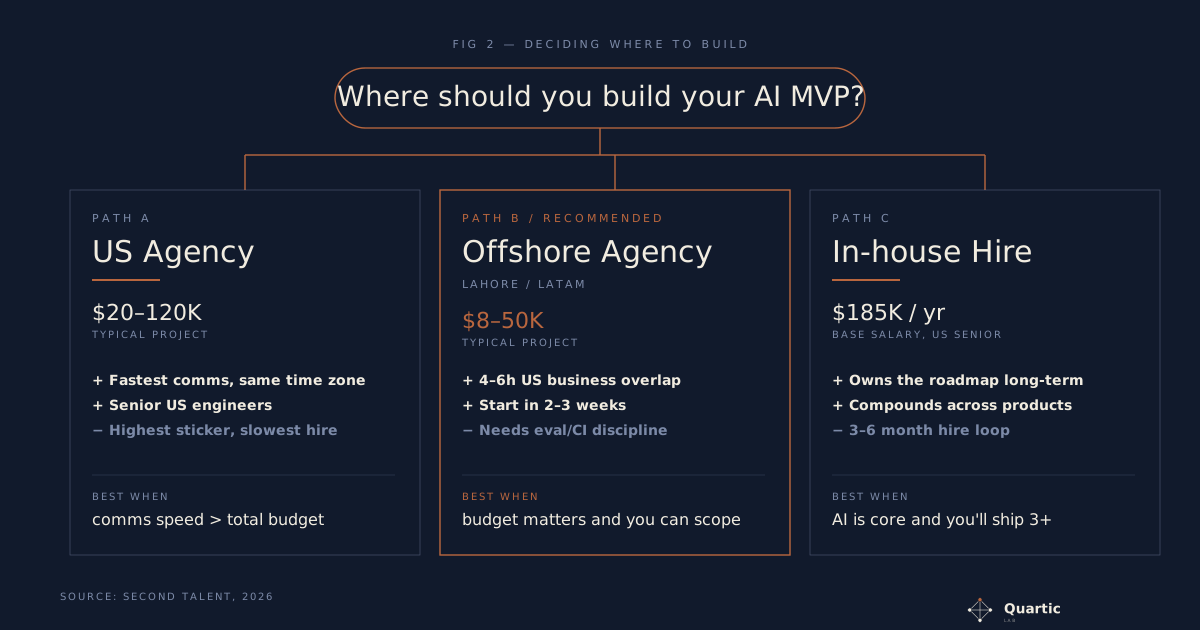
Is it cheaper to hire an offshore AI dev team or a US agency?
Yes, and the gap is bigger than most founders think. A senior US AI engineer fully loaded costs $15,000 to $22,000 per month. The same skill in LATAM lands at $8,000 to $13,000 — a 30 to 45 percent saving. Offshore Asia, including Pakistan, runs $3,500 to $6,500 per month, a 65 to 75 percent saving versus US, with a hiring loop that closes in two to three weeks instead of three to six months (Second Talent, 2026).
Three caveats that decide whether the savings are real:
- Time-zone overlap. Four to six hours with the US East Coast is the working minimum. Less than that and the build slows.
- Documentation discipline. Async-first teams ship faster than co-located ones, but only when they write things down (Second Talent, 2026).
- First-month ramp. Expect 60 to 70 percent productivity in week one. Structured onboarding pulls ramp from eight to ten weeks down to three to four (Second Talent, 2026).
A common pattern we see at Quartic Lab: a US founder pays a US agency $90K for an MVP they could have shipped at $35K with a Lahore-based team that already runs a US-overlap shift. The quality is a wash when the offshore shop has a real eval harness and CI in place. The price isn’t.
What gets you killed: the four mistakes that blow up the budget
We’ve shipped AI MVPs for teams that wrote a $30K check and teams that wrote a $300K check. The ones that fail rarely fail on price. They fail on scope.
- Building before validating. 42 percent of failed AI startups cite lack of market demand as the killer (CB Insights, cited in MVP failure analyses, 2025). Five customer interviews beat a fine-tuned model.
- Kitchen-sink scope. Cutting from five features to one core flow saves 40 to 50 percent of upfront cost (DesignRush, 2026). Every “while we’re at it” is a week of regression testing nobody scoped.
- Cheap model, expensive bill. Hard-coding GPT-4o or Opus on every call without prompt caching can turn a $40K build into a $3K–$5K-per-month token line at moderate volume (~50K queries/month with long context). Architect for caching and routing on day one.
- Skipping evals. No eval harness means no way to know when a prompt change breaks production. Budget 10 to 15 percent of dev hours for testing or pay for it later in support tickets.
After we added prompt caching to a long-context document-review tool for one client, the per-query cost dropped from $0.34 to $0.04 — an 88 percent reduction — while user-facing latency improved by roughly 600ms. Same model, same outputs, just a one-week refactor of how context was passed.
How we scope an AI MVP at Quartic Lab
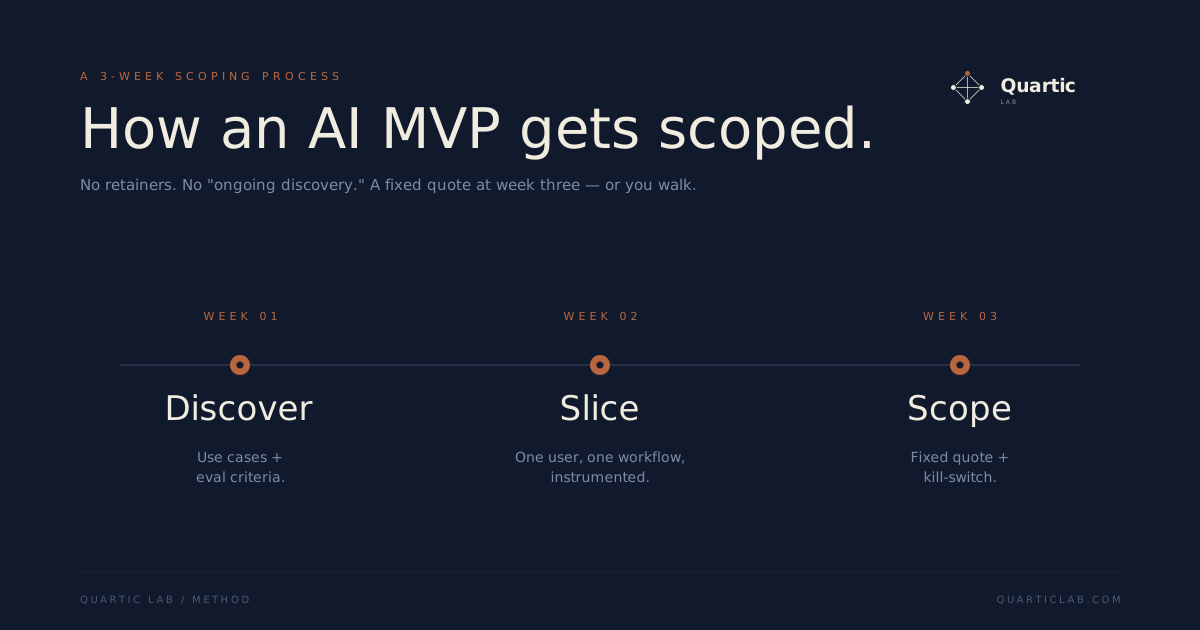
Three weeks of discovery, then a fixed build. Week one is use-case mapping and eval criteria — what does “working” mean, measured how. Week two is a thin vertical slice: one user, one workflow, end-to-end, instrumented. Week three is the full scope quote with line items and a kill-switch clause. We refuse to start a build without an eval harness and a token-spend dashboard wired in. Both prevent the two failure modes we see most often.
FAQ
How much does it cost to build an AI MVP in 2026?
Plan for $20,000 to $120,000 from a US agency, or $8,000 to $50,000 from an offshore-led team for the same scope. A simple reactive agent runs $20K–$35K US ($8K–$18K offshore) in four to six weeks; a mid-complexity workflow agent $40K–$70K US ($20K–$40K offshore); an autonomous multi-agent system $80K–$120K+ US ($50K–$80K offshore) (Productcrafters, 2026; Second Talent, 2026). Add 15 to 25 percent of build cost annually for maintenance, plus token and infra spend on top.
What’s the typical price range for an AI agent MVP from an agency?
Most agencies quote $25,000 to $80,000 for a production-ready AI agent MVP, with US shops landing 2 to 3x higher than offshore agencies for equivalent scope. The spread comes from team location, not skill — a senior offshore AI engineer costs $3,500 to $6,500 per month all-in versus $15,000 to $22,000 in the US (Second Talent, 2026). Ask for a phased quote with a kill-switch clause after the first slice ships.
Is it cheaper to hire an offshore AI dev team or a US agency for an MVP?
Offshore is 50 to 70 percent cheaper for equivalent scope when the team has a real eval harness, CI, and four-plus hours of US-business-hour overlap (Second Talent, 2026). The savings are real if you screen for documentation discipline and structured onboarding; otherwise the first-month ramp eats the gap. A Pakistan-based agency is the typical sweet spot for US founders — overlap with East Coast mornings, English-fluent senior engineers, and rates 65 to 75 percent below US averages.
How long does an AI MVP take to ship?
Four to sixteen weeks, again driven by complexity. Simple reactive agents ship in four to six weeks, mid-complexity in six to ten, autonomous systems in ten to sixteen (Productcrafters, 2026). AI-assisted development now compresses timelines 40 to 60 percent versus traditional cycles (DesignRush, 2026), but only when the team uses Cursor, Claude Code, or equivalent end-to-end — not just for autocomplete.
What are the hidden costs after the MVP launches?
Three line items founders miss: LLM token spend, observability, and compliance. Tokens, cloud, and retraining together hit 30 to 50 percent of first-year total cost of ownership (DesignRush, 2026). Annual maintenance runs 15 to 25 percent of build cost (Productcrafters, 2026). And SOC 2 or HIPAA, when they apply, add another 30 to 50 percent to the original quote (DesignRush, 2026). Architect for prompt caching and batch APIs early — Anthropic’s batch tier alone is 50 percent cheaper (Anthropic, 2026).
Can I build an AI MVP for under $20,000?
Yes, two ways. A no-code stack on Bubble, Glide, or n8n with a pre-built LLM API ships a thin proof-of-value for $5,000 to $15,000 (DesignRush, 2026) — fast to validate, but most teams rebuild it in code once real users hit. The other path is an offshore-led real-code build at $10,000 to $18,000 for a simple agent — slower than no-code, but you keep what you ship. Use no-code to validate demand, then write the dev check; or skip the no-code stage and go straight to an offshore code build if you already have signal.
Conclusion
An AI MVP is not a fixed price — it’s a scoped one. Pick the tier that matches the agent you’re actually shipping, demand a phased quote with a kill-switch, and architect for token costs on day one. If you want a scoped quote on your idea, book a 30-minute call with Quartic Lab and we’ll share the same three-week scoping process we use with every founder.
Sources
- AI Agent Development Cost: $5K to $180K+ (2026) — Productcrafters
- Offshore vs Nearshore vs Onshore AI Team Cost (2026 Breakdown) — Second Talent
- How Much Does AI Cost in 2026? Full Pricing Breakdown — DesignRush
- Notes on AI Apps in 2026 — Andreessen Horowitz
- Anthropic API Pricing 2026 — Finout
- How Much Does It Cost to Build an AI MVP in 2026? — Leanware