
Introduction
This guide shows founders how to hire an offshore AI development team that ships production code, not slide decks. It is written for early- and growth-stage founders who already know they need ML or agentic AI in their product but can’t justify a $190K salary plus equity for one in-house engineer. By the end you will know what to look for, what to pay, and what an onboarded pod actually delivers in the first two weeks.
Why founders are hiring AI engineers offshore in 2026
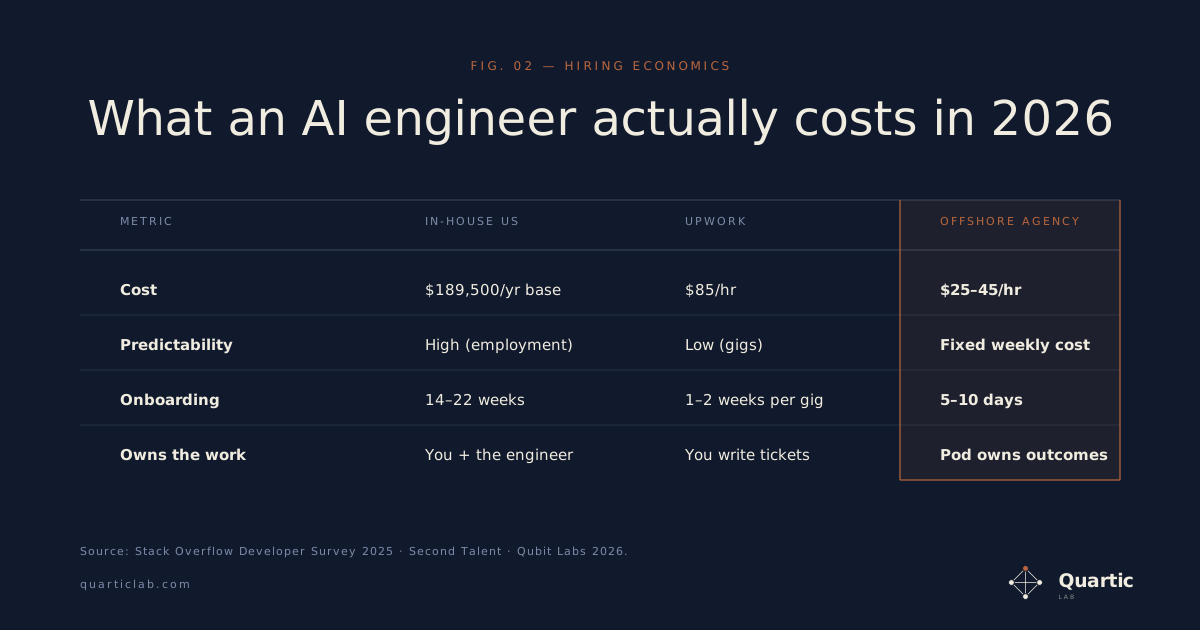
Three forces collided this year. AI startups captured 44% of all venture capital invested in 2025 (Founders Forum Group), pushing every funded company to ship an AI feature before its next round. The median US AI/ML engineer now costs $189,500 a year before equity, benefits, or recruiter fees (Stack Overflow Developer Survey, 2025) — over $50K above the global median. And more than 70% of US startups outsourcing software report they cannot fill advanced engineering roles domestically (Second Talent, 2025).
The result: 36% of US companies hiring AI development services in 2025 are doing it through offshore teams (Second Talent, 2025). Five years ago that number was a third of what it is today. The reason most founders give isn’t pure cost — it’s cost and speed. A US hire takes 14-22 weeks to source, vet, sign, and onboard. A vetted offshore team plugs in within 5-10 business days.
What does an offshore AI development team actually deliver?
A serious offshore AI team is not a body shop. It is three to five engineers (one ML lead, two full-stack, one MLOps/data) working as one pod under a single product manager who reports directly to your CTO or founder. The pod ships sprints, not tickets.
Deliverables a real AI pod owns end-to-end:
- Model selection and eval pipeline — picking between OpenAI, Anthropic, open-weight Llama/Qwen, or fine-tuned smaller models. Building a repeatable eval harness so you know when a prompt change made things worse.
- Agent loop and tool-use scaffolding — the production-grade skeleton most “ChatGPT wrappers” skip. Retry logic, tool-call validation, fallback prompts, observability.
- Data pipeline + retrieval layer — vector store, chunking strategy, freshness controls, citation tracking.
- Front-end integration — the part that decides whether your AI feature feels magical or broken. Streaming responses, structured outputs, graceful failures.
- MLOps + cost monitoring — token-spend dashboards, latency SLOs, model rollback paths.
A team that can’t speak fluently to four of those five is doing demos, not production. Ask to see eval reports and token-cost dashboards from previous engagements before signing.
How is hiring offshore different from posting on Upwork?
This is the single most-asked question we hear. The short version: offshore freelancers optimize for hours; an offshore team optimizes for outcomes. With a freelancer you manage the work — write tickets, review every PR, handle code review, debug their environment. With a real offshore agency pod, you set the outcome and the deadline; the pod owns everything between.
The longer version, in numbers. According to Qubit Labs, 2026 AI/ML engineer rates run $30-$60/hr in South Asia, $60-$100+/hr in Eastern Europe, and $130-$200+/hr in North America. A senior agency pod from Pakistan or Vietnam often lands in the same hourly band as a mid-tier Upwork freelancer, but ships an order of magnitude more code per week because the pod has internal QA, code review, and architecture support — none of which a solo freelancer can replicate.
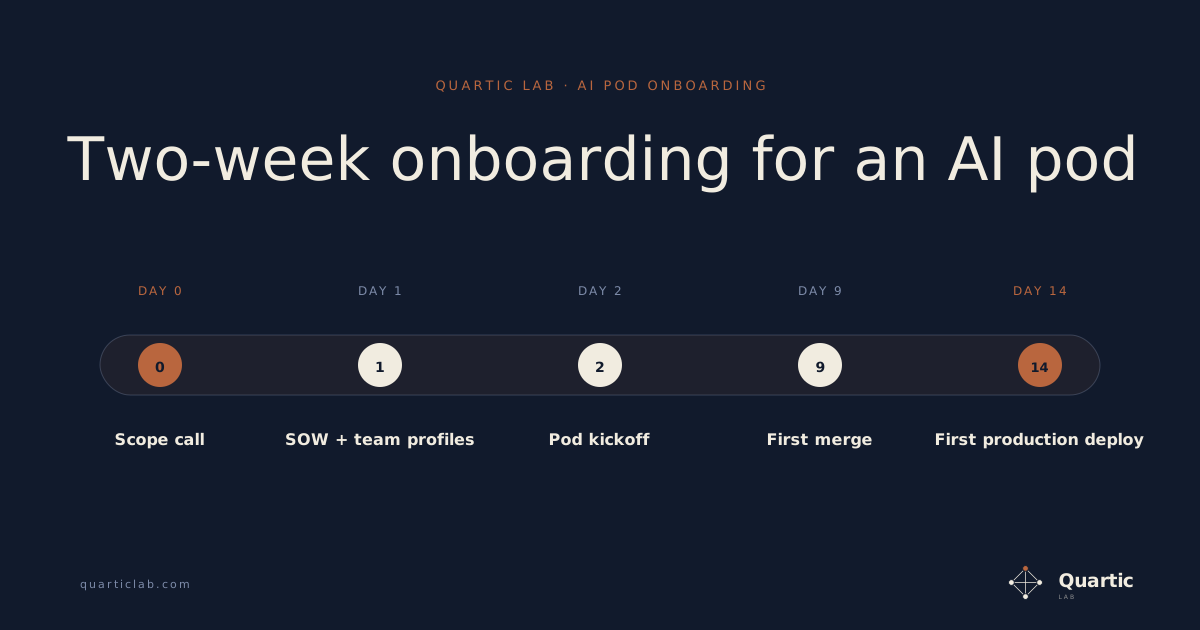
A US-based real estate tech company came to us needing AI-driven lead generation embedded directly into their existing CRM and owner monitoring pipeline. Their internal team had scoped it as a 3–4 month build. We embedded a 4-person pod within 9 days and shipped the first production endpoint in under two weeks — cutting their estimated timeline by more than 80%. No lengthy onboarding, no bloated sprints. Just a focused team moving at the speed their business actually needed.
What should you look for when vetting an offshore AI team?
Skip the “100+ AI projects delivered” marketing. Ask these instead, in this order:
- Show me an eval harness from a real client. If they can’t, they don’t ship production AI.
- What was your worst hallucination incident in the last six months and how did you catch it? Real teams have war stories. Demo-builders don’t.
- What’s your token-cost-per-active-user on your last engagement? A team that doesn’t track this number is going to surprise you with your OpenAI bill in month three.
- Who owns prompt regression tests? “We don’t run them” is a hard no.
- What’s the longest a model has been in production with you maintaining it? Six months minimum. A year is better.
If a team can answer four of those five with specifics, they are real. The price will sort itself out — there is no version of an unserious team becoming a bargain.
Time-zone overlap matters too. A US founder typically wants 4+ hours of daily overlap. Pakistan-based teams overlap with US East Coast 8-11 PM PKT (mornings for the founder); India does the same. Eastern Europe overlaps cleanly with both US East Coast and EU markets. None of this is a deal-breaker if the team has shipped across time zones before; all of it matters if they haven’t.
How Quartic Lab’s offshore AI development team works
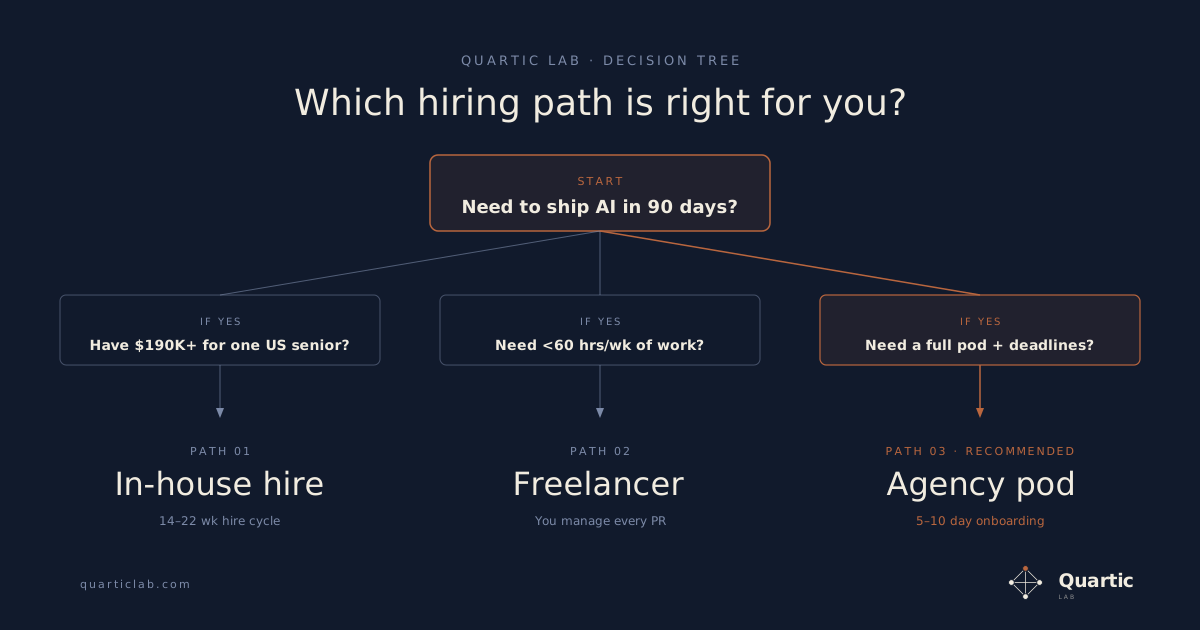
We ship from Lahore, Pakistan, with daily 5-hour overlap with US East Coast and full overlap with EU markets. Every Quartic Lab AI pod includes a senior ML engineer, two full-stack engineers (Python + React/Next.js), one MLOps engineer, and a dedicated PM who owns weekly outcome reports. Pods are billable weekly, not hourly — the contract is a commitment to ship a defined outcome inside a defined sprint window.
What this means for your runway: you swap a $190K/yr open headcount for a $12-18K/month pod that delivers more total throughput in the first quarter than a single in-house hire would. (a16z’s enterprise AI report found that buyers consistently underestimate how much production AI work is application engineering rather than ML research — which is exactly the gap a multi-discipline pod closes.)
FAQ
How much does it cost to hire an offshore AI development team in 2026?
For a four-person senior pod (ML lead + 2 full-stack + 1 MLOps), expect $12,000-$22,000 per month depending on region. Pakistan and Vietnam land at the lower end ($25-$40 effective hourly), Eastern Europe at the upper end ($60-$80). That’s roughly 15-25% of the all-in cost of one US senior AI engineer (Stack Overflow Developer Survey, 2025; Qubit Labs, 2026).
How long does it take to onboard an offshore AI team?
A pre-vetted agency pod is productive in 5-10 business days from contract signing. The first merge to your repo typically lands by day 7-10; the first production deploy by day 14. This compares to 14-22 weeks for sourcing, vetting, signing, and onboarding a single US in-house AI engineer (Second Talent, 2025).
Can an offshore team work in the same time zone as a US or European founder?
Yes — with the right region. South Asian teams (Pakistan, India) overlap 4-5 hours with US East Coast and 6-7 hours with EU markets. Eastern European teams overlap fully with EU markets and 4 hours with US East Coast. Any team claiming “24/7 coverage” without specifying which engineers are awake when is dodging the question — ask for a specific overlap window.
What’s the difference between hiring an offshore agency and freelancers on Upwork?
Freelancers handle assigned tickets; agency pods own outcomes. With Upwork you write the tickets, review every PR, debug their dev environment, and handle code review. With an agency pod you set the deadline and outcome — the pod owns architecture, QA, code review, and delivery. The hourly rate is similar; the throughput is not. Most US founders who have tried both report 2-3x more shipped functionality per dollar with an agency pod.
Is it safe to hire an AI development team from Pakistan?
Yes, when due diligence is done properly. Pakistan has a mature software export sector (over $3 billion in software exports for FY 2024), strong English-language proficiency, and a growing AI engineering talent pool. The risks are not country-specific — they are agency-specific. Vet for IP protection clauses, clear data-handling agreements (especially for HIPAA/GDPR cases), GitHub access controls, and direct references from at least two previous US/EU clients. A serious agency will provide all four without being asked.
Ready to scope your AI build?
Tell us what you want to ship in the next 90 days. We will return a scope, a team profile, and a fixed weekly cost inside 12 hours. Book a 30-minute scoping call →
Sources
- 2025 Stack Overflow Developer Survey — Developers remain willing but reluctant to use AI
- Second Talent — AI Adoption in Enterprise Statistics & Trends 2025
- Qubit Labs — Guide to Offshore Software Development Rates by Country 2026
- Andreessen Horowitz — Where Enterprises Are Actually Adopting AI
- Founders Forum Group — AI Statistics 2024–2025: Global Trends, Market Growth & Adoption Data